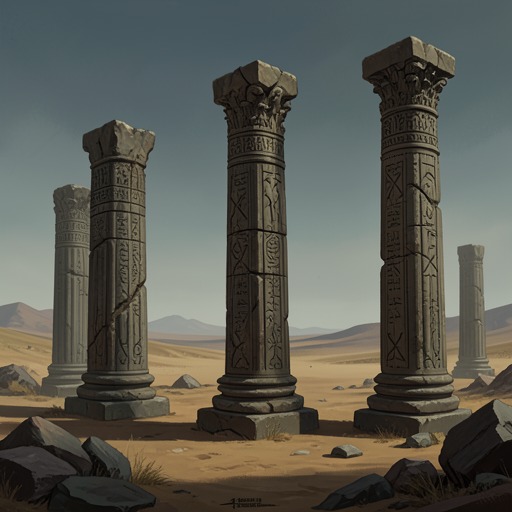
Agartha’s sealed gates against Topsiders
5 Centimeters per SecondAgartha’s sealed gates against Topsiders are both a means of controlling access and a response to a history of exploitation. The doors were closed with the Clavis after surface rulers repeatedly took Agartha’s wealth and knowledge and brought wars in return; their closure marks a people’s attempt to keep that violence from recurring. The rule is made tangible when a concealed door in a rock wall yields to the Clavis, revealing a passage into the underground world.
Origins and Purpose
The gates belong to a history that begins before Agartha’s later isolation. Morisaki explains that the Quetzal Coatls, ancient gods who had guided humanity, withdrew underground after humanity had outgrown them. They left gatekeepers behind, and a few clans followed them. This account establishes an older pattern of withdrawal and guarded passage, but it does not equate the gods’ departure with the later decision to seal the entrances against surface people.
The elder gives that later decision a specific political cause. For several centuries, emperors and kings from the surface plundered Agartha’s wealth and techniques. They wanted its knowledge and riches to strengthen their control of the surface, while the exchange brought repeated wars to Agartha. The elder recalls that its cities had once surpassed any on the surface in magnificence; all were destroyed, the population dwindled, and only a few villages remained. Closing the doors with the Clavis was the response to this devastation: a way to prevent Topsiders from entering and repeating the pattern of taking and violence.
The Clavis and the Hidden Entrance
The rule operates through a specific object and a concealed threshold. After armed men attack a Quetzal Coatl, their leader directs some of his men to guard a boy and approaches what they suspect is a door in the rock. One man asks whether it is the entrance. The leader recalls that explosives and rock drills failed to breach the one at the South Pole, then pushes Asuna toward the barrier and tells her to touch the light with the Clavis.
Asuna has little choice but to comply. When the tip of the Clavis touches the light, the apparent rock door vanishes and exposes a stone corridor. The passage is in unusually good condition: its ancient-looking stone is worn, with a few plants growing in it, yet it is far too orderly to be mistaken for a ruin. The leader exhales in admiration. The scene shows that the sealed entrance is not simply an obstacle that force can overcome; the tools used against the South Pole door have achieved nothing, while the Clavis opens this one. The account does not establish that every gate works identically, but it connects the Clavis directly to the opening of this hidden threshold.
The Rule in Practice
The elder’s explanation gives the barrier a human cost as well as a defensive purpose. To the people who endured the destruction of their cities and the loss of their numbers, a visit from Topsiders is a bad omen. That reaction is not presented as an abstract hostility toward outsiders: the elder links it to the long record of surface rulers arriving for Agartha’s resources and knowledge, with war following in return. The gates preserve a boundary shaped by remembered consequences.
The account also distinguishes physical access from welcome. The entrance can be opened, and the corridor beyond it remains passable; the policy is not that Agartha has ceased to exist or that every route has disappeared. Rather, access is controlled through doors that the people of Agartha deliberately closed. The armed men’s interest in the entrance, and the leader’s use of Asuna and the Clavis to open it, place that control under immediate pressure without changing the elder’s account of why the boundary was made.
Historical and Narrative Significance
The sealed gates turn Agartha’s history into architecture. The ruined cities and dwindling population explain the rule, while the hidden door makes its consequences visible: entry depends on a threshold that can resist ordinary force and requires the Clavis to open. In this way, the boundary is at once defensive and vulnerable—not because the text says the policy has failed, but because the scene shows outsiders seeking access and the door opening under their pressure.
The elder’s conduct further complicates the rule without undoing it. After explaining why Topsiders are unwelcome, he invites Morisaki to see his library, while asking Asuna to help with dinner preparations. The account does not say that the gates are abandoned or that the historical danger is resolved. Instead, it sets a guarded policy beside a limited act of hospitality: the reasons for exclusion remain, even as the people who live behind the boundary decide how to respond to those who have crossed it.